Joint Bachelor of Science in Nursing (BSN)

A Four-Year Nursing Degree from CofC and the MUSC College of Nursing

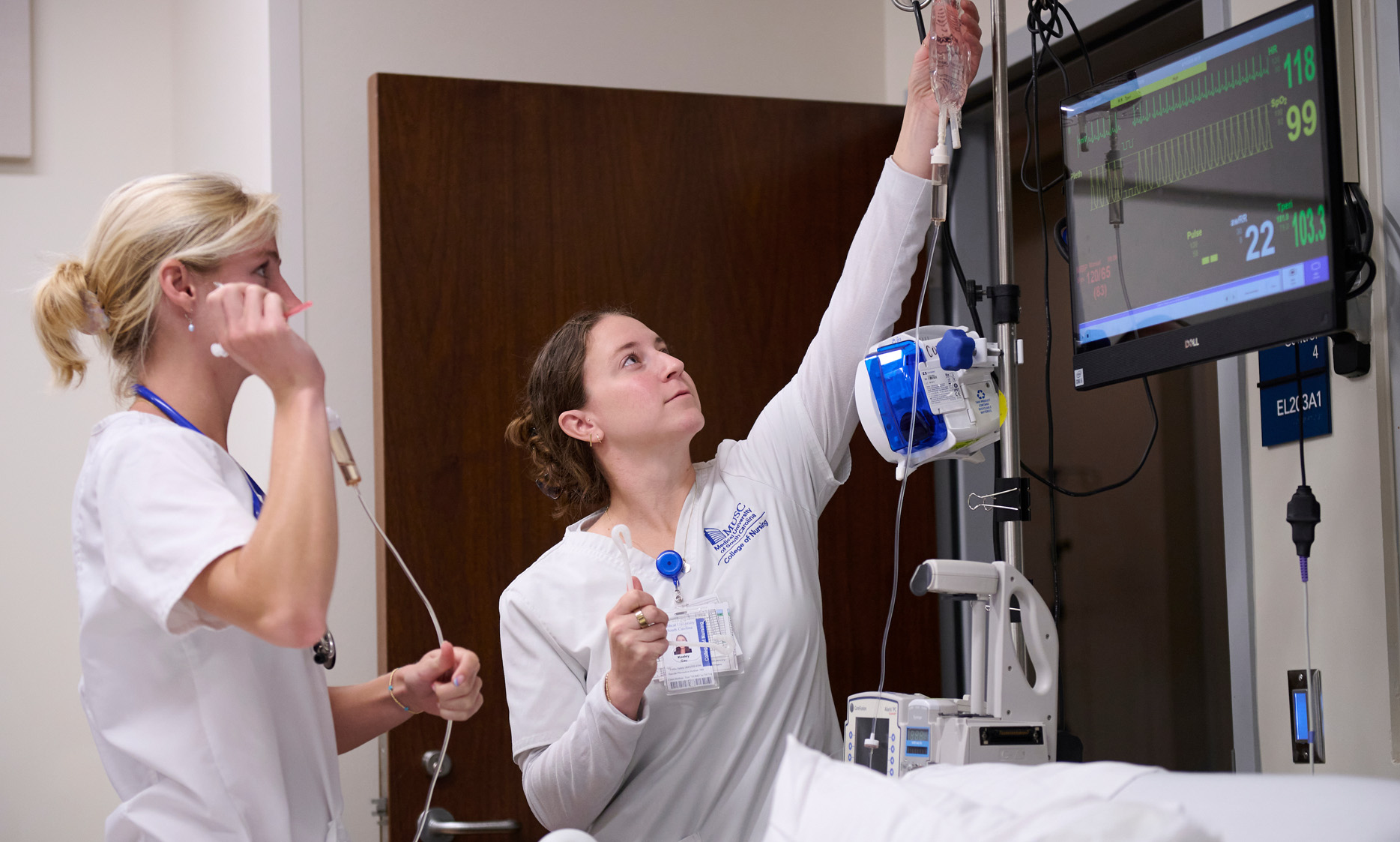
Two student nurses adjustan IV bag in a nurse training simulation

Study at COFC & MUSC College of Nursing

Earn your Bachelor of Science in Nursing (BSN) through a unique four-year joint program with the College of Charleston and the Medical University of South Carolina (MUSC) College of Nursing.

You’ll combine a traditional undergraduate education at CofC with hands-on clinical training designed and delivered by MUSC Faculty in top-tier medical facilities at MUSC and its affiliated training facilities.

Why Study Nursing at the College of Charleston & MUSC?


The Joint BSN program at the College of Charleston and MUSC College of Nursing can help you turn your interest in healthcare into a meaningful profession with opportunities to grow, specialize and lead.

  • Gain the full College of Charleston Education: Build a strong academic foundation at the College of Charleston while developing the communication, critical thinking and problem-solving skills needed to care for patients and work with healthcare team.
  • Secure your place with Direct Admission: A direct admit option is available to highly qualified high school seniors who wish to pursue the joint BSN degree with College of Charleston and MUSC College of Nursing. First-year students offered direct admission must still meet program requirements to progress into the Upper Division. Direct admission does not waive those requirements. 
  • Benefit From Nursing Experts: Learn from MUSC College of Nursing faculty who bring specialized nursing education expertise to the classroom. Gain professional connections to the Charleston healthcare community.
    Clinical experiences may occur outside of MUSC facilities, based on placement availability and type of clinical experience required.
  • Learn Beyond the Classroom: Prepare for nursing practice through hands-on learning, skill development and clinical experiences at MUSC and its affiliated training facilities around the state.
  • Prepare for What's Next: Develop the knowledge and profession skills needed to pursue nursing licensure (NCLEX-RN) to become a registered nurse and begin a career in a field where you can make a meaningful difference.

The Joint BSN program is currently seeking approval from the South Carolina Board of Nursing.

About the Program


Begin your nursing journey with two years of traditional undergraduate study with the College of Charleston and complete your upper-division nursing education with MUSC College of Nursing faculty. You'll be on track to graduate with a Joint Bachelor of Science in Nursing (BSN) degree from CofC and MUSC College of Nursing in four years.

Pre-Nursing (Years 1 & 2): Complete your general education courses and build your foundational scientific and healthcare knowledge with nursing prerequisite courses.

Upper Division (Years 3 & 4): Take nursing courses taught by MUSC faculty on the CofC campus, with clinicals taking place at MUSC hospitals and affiliates around the state.

01 First Year Foundations

Begin your college experience at CofC, exploring foundational sciences and completing introductory coursework to prepare for nursing study.

  • Complete foundational coursework.
  • Build a strong science background.
  • Explore the nursing profession.
02 Second Year Scientific Base

Build on your foundational scientific knowledge to prepare for entry into clinical-focused coursework with MUSC College of Nursing faculty.

  • Progress in advanced science coursework.
  • Prepare for nursing-focused study.
  • Completion of pre-requisite requirements and apply for upper division.
03 Third Year Nursing Core

Advance into focused nursing coursework to progress the knowledge and technical skills needed for patient care

  • Build core nursing knowledge.
  • Develop practical clinical skills.
  • Receive active instruction from MUSC faculty.
04 Fourth Year Launch Your Career

Continue through specialized nursing education coursework and clinical experiences in the MUSC network with the MUSC College of Nursing as you prepare for graduation and a path toward licensure as a registered nurse.

  • Strengthen clinical judgment.
  • Complete required clinical experiences.
  • Prepare for the next step toward licensure.

Joint BSN Courses & Curriculum


Explore the four-year BSN curriculum, from foundational coursework in the sciences and general education to advanced nursing studies and hands-on clinical experiences. Each year builds on the knowledge and skills you developed in the previous year, preparing you to deliver compassionate, evidence-based care and begin your career in nursing.
  • Year 1: Foundations

    Year 1: Fall

    • BIOL 111 & Lab/BIOL 101 & Lab:
      A foundation course for science majors emphasizing the concepts of structure and function in biological systems at the molecular and cellular levels. Topics include biochemistry, biochemical and molecular evolution, cell function, respiration, photosynthesis, genetics and molecular biology.
    • FYE Intro to Nursing: Explore the foundations of professional nursing, including critical judgment, compassionate care, ethics, communication and evidence-based practice. Develop reflective practice, resilience and professional goals while building skills for holistic, person-centered care.

    • Math (1 of 2) MATH 104 Elementary Statistics: Master probability concepts, descriptive statistics, binomial and normal distributions, confidence intervals and hypothesis testing. (Satisfies first year three credits of math/logic general education requirement)

    Year 1: Spring

    • BIOL 112: Evolution, Form, and Function of Organisms & Lab: Explore evolution and the major groups of organisms, emphasizing their structure, form, and function.
      - Or -
      BIOL 102: Concepts and Applications in Biology II & Lab: Explore organism anatomy and physiology, ecology, evolution, biodiversity, and conservation biology. Examine how scientific methods and discoveries help explain contemporary biological and environmental issues.
    • Math (2 of 2)- MATH 250: Statistical Methods I: Develop foundational statistical skills in descriptive statistics, probability, estimation, hypothesis testing, correlation, and regression. Apply statistical methods and software to analyze data and interpret results.

    • Foreign Language (2 of 4) - Complete the 202-level or its equivalent or demonstrate proficiency at that level of an approved course satisfying the foreign language general education requirement.
    • Humanities (1 of 4): Select from a list of approved courses satisfying the humanities general education requirement
    • Social Science (1 of 2) PSYC 103: Introduction to Psychological Science: Explore the scientific study of human behavior, including research methods, brain function, sensation and perception, learning, memory, social psychology, and psychological disorders.

    • History (1 of 2): Complete one course in pre-modern history and one course in modern history from the list of approved courses satisfying the history general education requirement. 

  • Year 2: Scientific Base

    Year 2: Fall

    • BIOL 221 & Lab: Human Anatomy and Physiology I: Study the structure and function of the human body's nervous, muscular, skeletal, and cardiac systems, exploring both gross anatomy and microscopic structures through lectures and laboratory experiences.

    • Humanities (2 of 4): Select from a list of approved courses satisfying the humanities general education requirement.
    • BIOL 225: Human Microbiology: Explore the microorganisms that cause infectious diseases, how infections spread, and the role of normal microflora in human health. Develop foundational skills in infection prevention and the use and interpretation of laboratory tests to help diagnose infectious diseases.

    Year 2: Spring

    • BIOL 222 & Lab: Human Anatomy and Physiology II: Study the structure and function of the human body's vascular, respiratory, renal, digestive, immune, endocrine, and reproductive systems through lectures and laboratory experiences.
    • Humanities (4 of 4): Select from a list of approved courses satisfying the humanities general education requirement.

    • Social Science (2 of 2) PSYC 224: Lifespan Development
      Examine human development from conception through the end of life, exploring physical, cognitive, emotional, and social changes over time. Consider key developmental theories and research findings that explain how people grow and change.

    • PBHL 257: Principles of Nutrition: Explore essential nutrients, current dietary guidelines, and the relationship between food choices and long-term health. Apply nutrition and activity assessments to support health-conscious decisions and understand how lifestyle choices influence disease risk.

  • Year 3: Nursing Core

    Upper-division nursing courses follow a structured sequence. Students must successfully complete all coursework in one semester before progressing to the next. Courses in each semester build on the knowledge and skills developed in previous semesters.

    Year 3: Semester 5

    NURSU 315: Health Assessment*
    Develop skills in comprehensive health assessment across the lifespan, including collecting and interpreting patient data to guide clinical decisions. Emphasize patient safety, compassionate communication, and equitable, evidence-based care.

    NURSU 451: Pathophysiology-Pharmacology I
    Explore the principles of pharmacology and pathophysiology to support safe, effective medication administration. Develop skills in dosage calculations, identifying medication-related risks, and applying evidence-based practices to promote patient safety.

    NURSU 461: Foundations & Gerontologic Nursing*
    Develop critical-thinking and clinical judgment skills while learning foundational nursing practices for adult and older adult patients. Apply health assessment findings, pathophysiology concepts, and communication skills in hospital-based clinical settings.

    Year 3: Semester 6

    NURSU 452: Pathophysiology-Pharmacology II
    Build on foundational pharmacology and pathophysiology knowledge to strengthen medication administration skills and promote patient safety. Advance competency in dosage calculations, medication risk management and the use of healthcare technologies and resources.

    NURSU 464: Research and Evidence-Based Practice in Nursing
    Develop skills in formulating clinical questions, evaluating research, and applying evidence to improve nursing practice and patient outcomes. Collaborate to analyze research findings and communicate evidence-based recommendations that advance nursing knowledge and quality of care.

    NURSU 454: Medical-Surgical Nursing I*
    Apply clinical judgment, health assessment, and nursing knowledge to develop individualized care plans for patients with complex medical needs. Through classroom learning and clinical practice, develop skills in managing symptoms, preventing complications and promoting recovery in acute care settings.

    NURSU 387: Psychiatric and Mental Health Nursing*
    Explore the biological, psychological, and sociocultural factors that influence mental health and psychiatric disorders. Develop skills in mental health assessment, therapeutic communication and evidence-based interventions to provide culturally responsive care.

    *Clinical Courses


  • Year 4: Launch Your Career

    Year 4: Semester 7

    NURSU 409: Population-Focused Nursing*
    Explore strategies to improve population health through health promotion, disease prevention, and attention to social determinants of health. Apply principles of health equity, risk reduction, and interprofessional collaboration across diverse healthcare settings.

    NURSU 417: Women's Health*
    Explore women's health across reproductive health, pregnancy, birth, and newborn care, considering physical, emotional, and social needs. Develop assessment, communication, and advocacy skills to provide safe, compassionate, evidence-based care for women and families.

    NURSU 405: Nursing Care of Children and Their Families*
    Explore pediatric nursing practices that address children's health needs across developmental stages and healthcare settings. Develop clinical judgment and communication skills to provide safe, compassionate, evidence-based, and family-centered care.

    NURSU 472: Professional Practice Seminar II*
    Build on foundational nursing competencies while exploring systems thinking, quality improvement, and patient safety. Strengthen clinical judgment, reflective practice, and professional development through continued work on a professional ePortfolio.

    IP 711: IP Foundations & TeamSTEPPS
    Develop foundational skills in interprofessional collaboration, teamwork and communication to improve patient care and population health outcomes. Explore professional roles and evidence-based strategies for effective healthcare teams.

    IP Elective (Concentration)
    Explore a selected concentration through an interprofessional learning experience that expands understanding of collaborative healthcare practice.
    *IP courses may be offered in a different semester, depending on upper division start date.

    Year 4: Semester 8

    NURSU 372: Healthcare Systems and Policy
    Examine how healthcare systems and public policy influence nursing practice, patient care, and health outcomes. Explore healthcare policy, advocacy, leadership, and the social, economic, and environmental factors that shape access to and delivery of care.

    NURSU 376: Leadership and Management in Nursing
    Develop essential nursing leadership and management skills, including clinical prioritization, delegation, communication, and ethical decision-making. Explore ways to promote patient-centered care, collaborate across healthcare teams, and improve care delivery.

    NURSU 455: Medical-Surgical Nursing II Synthesis Practicum*
    Build advanced clinical judgment and critical-thinking skills while caring for patients with complex medical needs, including an introduction to critical care. Integrate assessment, pathophysiology, pharmacology, and evidence-based practice to develop individualized care plans and support patient recovery.

    NURSU 473: Professional Practice Seminar III
    Explore interprofessional practice and collaboration through a selected focus area, such as palliative care, telehealth, mental health, or population health. Integrate professional nursing competencies and complete a professional ePortfolio demonstrating learning and development.

    *Clinical Courses
Apply Now


Begin your rewarding career in nursing and apply now. Earn your BSN through a four-year joint program that combines the traditional college experience at the College of Charleston with the nursing education and clinical expertise of the Medical University of South Carolina College of Nursing.

Apply Now