Music Department Frequently Asked Questions
Let us help you with important information about our academic programs, audition requirements, admissions process, scholarships, performance opportunities, and student life.
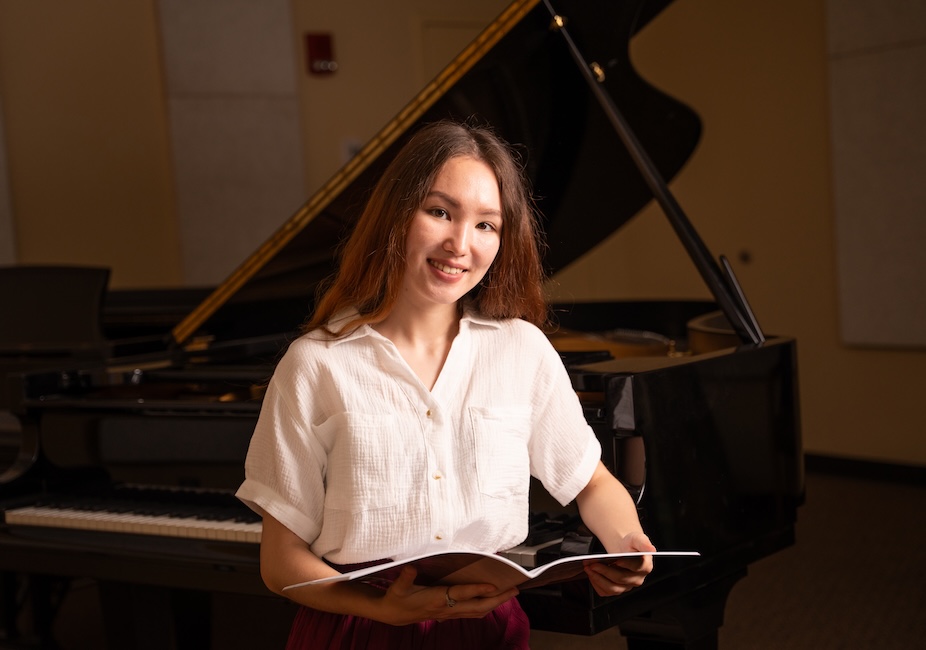

Alina's Experience
“Our music department is like a family to me. I found some of my best friends here who are also major music students. There is also one specific thing that I like in our music department - we have the best and the most supportive professors! " -Alina Galiyeva (Music-Piano Performance, 2026)
Preparing for College FAQ
-
Are there scholarships available? How do I apply?
Yes! As a public institution, the College of Charleston offers tuition rates that many applicants find attractive and competitive compared with other schools they are considering.
Steps to become a music major:
- Apply for admission to the College.
During the admissions process, the Office of Admissions may identify academic scholarships for which you qualify and will guide you through those opportunities. - Apply for a Music Department Scholarship, which is available exclusively to music majors.
Based on an audition and interview, the department may award Merit Awards (which reduce out-of-state tuition to the in-state rate), Music Excellence Awards, and additional funding through endowed scholarships. Some scholarships are designated for specific areas, such as voice, strings, or piano.
Particularly outstanding applicants may receive multiple awards. Some endowed scholarships also have specific eligibility requirements, such as financial need or academic standing.
In addition to scholarships, the department presents annual awards to continuing and graduating students in recognition of excellence, leadership, service, and good citizenship. Many of these awards are also tied to specific areas of musical study or activity.
- Apply for admission to the College.
-
What is the audition process?
Prospective music majors who wish to be considered for Music Department Scholarships must first apply to the College of Charleston and then complete the department’s scholarship application process.
South Carolina residents are invited to attend one of our audition and interview days, typically held on Saturdays in February. Applicants perform two contrasting works and participate in an interview with music faculty. The interview gives us an opportunity to get to know you, learn about your goals, and discuss how our program can support your development.
Out-of-state students are encouraged to audition in person whenever possible but may submit video recordings in place of a live audition. Virtual interviews can be arranged when needed.
-
Can I study music and still pursue another major or career path?
Understanding the differences between these educational models is an important part of choosing the right program.
At the College of Charleston, students earn a Bachelor of Arts (B.A.) degree with a major in Music within a liberal arts environment. This means that, in addition to your music coursework, you will complete classes across a variety of disciplines. The result is a broad educational foundation that develops skills valued by employers, graduate programs, and communities alike.
At many larger universities, students may pursue a Bachelor of Music (B.M.) degree. These programs typically require a greater concentration of credits within a specific musical discipline, leaving less room for coursework outside the major. For students who are committed to a highly specialized path, this can provide additional depth of study. Because the degree requires more major-specific credits, pursuing a double major is often more challenging.
Both approaches offer advantages. We value the flexibility and breadth of the liberal arts model while maintaining the rigor and individualized attention serious musicians need to thrive.
More than half of music majors are double majoring in other areas, and many are also combining their studies with the renowned Honors College. The College of Charleston continues to expand its careers support through programs such as pre-med and pre-law advising.
Students also benefit from studying at an institution focused on undergraduate education. Unlike at many larger universities, you will not compete with graduate students for performance opportunities, faculty mentorship, or access to resources. Your courses and applied instruction are taught by faculty members, not teaching assistants.
-
How should I choose where to study?
Choosing a college is a significant decision, and there are many factors to consider. We encourage you to speak with your family, teachers, counselors, and mentors throughout the process.
For aspiring music majors, the quality of the faculty, the strength of the program, and the opportunities available for performance and professional development are especially important. Opportunities to build your experience, résumé, and professional network can have a lasting impact on your future success. Financial considerations may also play a major role in your decision.
Just as importantly, choose a place where you can picture yourself living, learning, and thriving for the next four years.
“The music department was a very close community, and I felt like I could go to my professors and peers with any questions I had regarding music or other classes.
Lucy Richmond (Music and Biology, 2025):
Life as a Cougar FAQ
-
What does a music major involve?
There is no single answer, as every student’s path reflects their interests and goals. However, students often ask about the core curriculum.
Music majors progress through the program as part of a close-knit cohort. During the first year, students typically take Music Theory I and II, Aural Skills, and courses that strengthen their understanding of music history, style, and listening.
The major includes:
- four semesters of Music Theory,
- two semesters of Music History,
- and a Music as Culture course.
The result is a balanced curriculum that combines academic study, performance experience, and individualized artistic development.
-
What performance opportunities are available?
One of the advantages of studying music at the College of Charleston is what we often describe as the “sweet spot” we find ourselves in as a smaller college department in a vibrant cultural city.
Charleston offers the opportunities and resources of a larger city while maintaining the close-knit atmosphere of a smaller community. As a result, our students enjoy performance opportunities that might be significantly more competitive at larger institutions and their respective cities.
Students perform regularly in large and small ensembles, including orchestral performances, chamber music concerts, jazz combo performances, and touring opportunities.
The International Piano Series brings some of the world’s leading pianists to campus for concerts and master classes. In addition to participating in these educational experiences multiple times per year, students perform as soloists, chamber musicians, and concerto performers. They are also supported through competitions.
The Piccolo Spoleto Festival and the Notes at 11 Series regularly feature student performances in historic venues both on and off campus. Many of our students are also active performers throughout Charleston in churches, arts organizations, restaurants, and other community venues. Students leave CofC with impressive performing experience and resumes.
-
What professional opportunities are available?
In addition to extensive performance experience, students have access to:
- internships,
- work-study opportunities,
- other professional experiences in areas such as teaching, accompanying, piano technology and maintenance, arts administration, and community engagement.
These opportunities help students develop practical skills and build professional networks while still in college.
-
What if I’m interested in more than one area of music?
The Bachelor of Arts degree is designed to provide flexibility.
Many of our students pursue multiple interests within music, and faculty advisors work closely with students to design a course of study that aligns with their goals. Whether your interests span performance, composition, conducting, music history, ethnomusicology or another area, we can help you build a meaningful and rewarding academic path.
-
Is there a friendly and supportive community in the Music Department?
Yes. One of the things we value most is the supportive culture among our students.
Research consistently shows that building strong connections with peers in your area is one of the most important factors in determining student success at the college level. The music curriculum naturally fosters these relationships through shared classes, ensembles, performances, and projects.
While students may occasionally compete for selective opportunities, we are proud of the positive balance of ambition, collaboration, and camaraderie that characterizes our department.
-
What is it like living in Charleston as a student?
Charleston is consistently recognized as one of the most desirable cities in the United States and remains a premier destination for visitors from around the world. Rich in history, culture, and the arts, it offers students an exceptional place to live and learn.
The campus is located in the heart of historic downtown Charleston. Its brick walkways, historic architecture, and oak trees draped with Spanish moss create a setting unlike any other.
Students enjoy easy access to beaches, restaurants, cultural events, and a thriving arts community, all within minutes of campus.
-
What is the curriculum like for music majors at College of Charleston?
The College of Charleston combines the personalized experience of a tailored music program on a liberal arts campus with the academic rigor of a nationally recognized public university.
Small class sizes allow students to work closely with faculty mentors, engage actively in discussions, and receive individualized support. Music majors benefit from this environment both within the department and across the broader curriculum.
Our graduates go on to successful careers and graduate study, inside and outside of music, because they leave College of Charleston with strong analytical, communication, and problem-solving skills alongside their musical training.
I just finished my first year of Master in Piano Performance at Mannes School of Music! I am preparing for a concert in France, and two concerts for the Mannes Sounds Festival.
Clara Camacho (Music-Piano Performance, 2024; Post-Baccalaureate-Piano Performance, 2025)
Life after Graduation FAQ
-
What career opportunities are available after graduation?
Our graduates pursue a wide variety of professional and educational paths.
Many continue their studies at leading graduate programs in music and other disciplines. Others begin careers as performers, composers, educators, arts administrators, and creative professionals.
A music degree also develops highly transferable skills, including discipline, organization, communication, collaboration, creativity, and critical thinking. These are further developed by the liberal arts curriculum. These qualities are valued by employers across many industries, and our alumni have built successful careers in fields both within and beyond music.
-
Who is eligible for the Post-Baccalaureate Artist Residency?
The Post-Baccalaureate Artist Residency is designed for musicians seeking additional time to develop repertoire, performance experience, and artistic confidence before entering graduate school or launching a professional career.
While the program is particularly valuable for recent CofC graduates, talented and dedicated applicants from other institutions are welcome and encouraged to apply.
Having more time to focus on music through the Artist Diploma helped me prepared for grad school. Additionally, accompanying undergrad students for their juries was also a formative opportunity.
Clara Camacho (Music-Piano Performance, 2024; Post-Baccalaureate-Piano Performance, 2025)