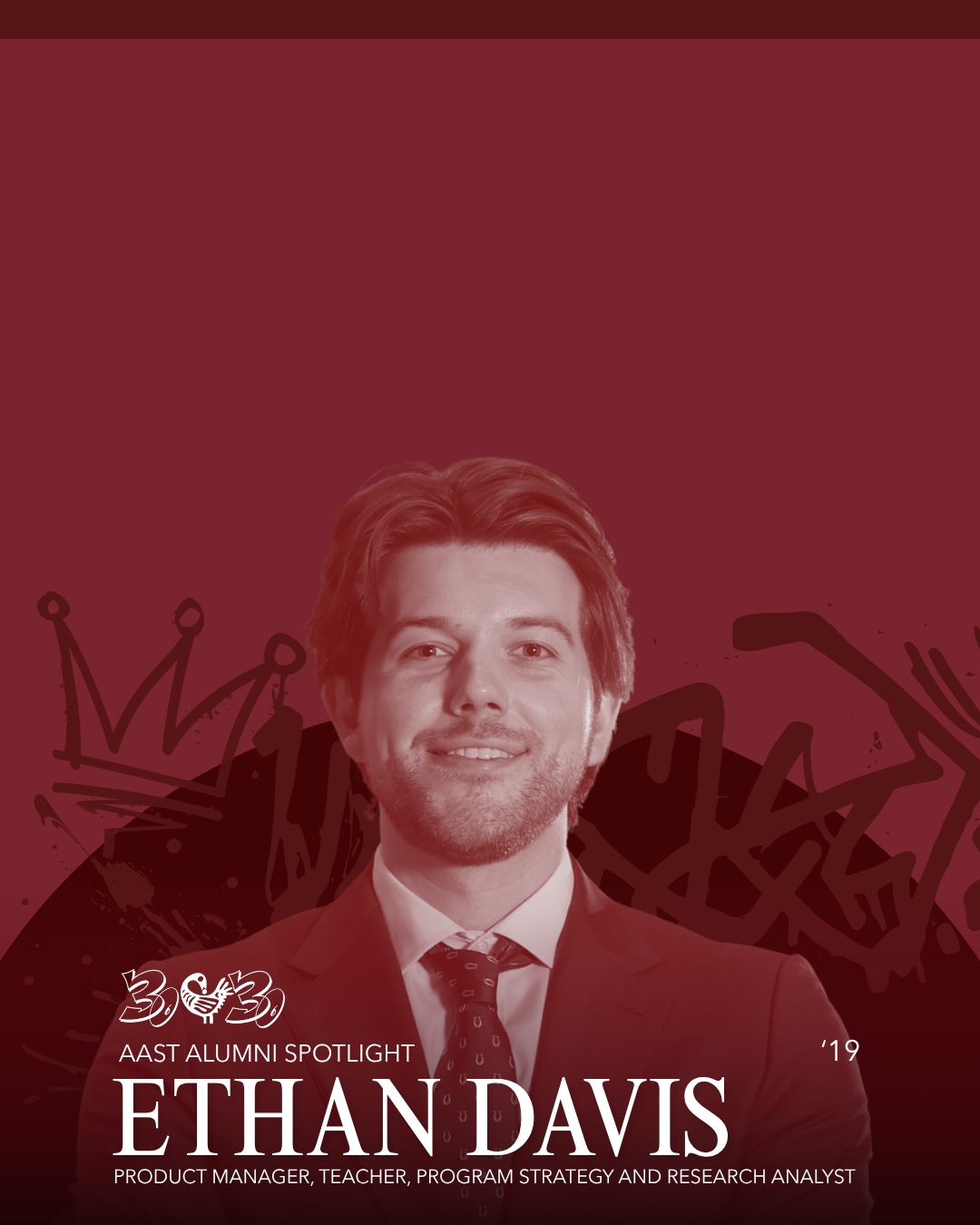
Alumni Spotlight: Ethan Davis
As part of our 30th Anniversary celebration, we’re shining the spotlight on our amazing alumni! We’re proud to feature Ethan, an AAST alumnus!
Ethan Davis ’19 has built a career at the intersection of education, community development, technology, and strategy. A graduate of African American Studies and Political Science, with a minor in Jewish History, Davis has carried the analytical and people-centered perspective he developed as an undergraduate into work spanning the nonprofit, education, and technology sectors. Today, Davis is an MBA ’26 graduate of Cornell’s SC Johnson College of Business, where he served as President of Out4Business and was a Johnson Leadership Fellow, Emerging Markets Fellow, Consortium Fellow, and ROMBA Fellow. He is now pursuing product and client-facing opportunities with AI-native startups in New York City while continuing freelance product and strategy work. Davis’s career has taken him through a range of environments and communities. After college, he spent two years with Teach For America on the Navajo Nation, where he taught English and history and developed six courses from scratch in an environment without existing instructional materials. He later moved to the San Francisco Bay Area, working as a Product Manager at Code Nation, developing coding programs for underrepresented high school students. Earlier in his career, Davis spent three years with Metanoia, an asset-based community development organization in North Charleston, where he worked in program strategy and research, K–12 instruction, and volunteer coordination. Across those experiences, Davis says African American Studies gave him a framework for understanding the communities and systems he was entering. “The main thing African American Studies gave me is the power of the zoom out. It taught me not to take things at face value.” That perspective, he says, shaped how he approached each new environment—not by arriving with predetermined solutions, but by first understanding its history, existing strengths, and local context. “You don't arrive with the solution,” Davis explains. “You learn the history of the place, find out what's already working, and build from there.” At first glance, Davis’s move into technology and AI might seem far removed from his undergraduate studies. For him, the connection is direct. He argues that some of the most difficult challenges in technology adoption are not technical. They are questions of trust, organizational change, and whether people see themselves reflected in the systems being introduced. Davis has explored these questions through his product work, including building and running an AI advising agent for Cornell’s career center. His interests now include AI adoption as a people problem, the boundaries between AI prediction and human judgment, and designing systems that know when to hand a decision back to a person. “The hardest problems in deploying technology aren't technical,” Davis says. “They're about whether the people who have to use it trust it and see themselves in it.” For Davis, that is a continuation—not a departure—from the questions he began asking as an African American Studies student. When reflecting on what his undergraduate education continues to contribute to his work, Davis identifies three principles. Context matters. Experiences in the Gullah Geechee corridor, on the Navajo Nation, and in different communities within North Charleston demonstrated to him that there is no universal playbook. Solutions have to be understood within their particular histories and circumstances. Fluency across differences matters. Davis describes genuine curiosity about how other people think as an essential part of building effective teams. He believes that meaningful innovation often comes from perspectives encountering one another in ways they would not have independently. Primary sources matter. His AAST training taught him to look beyond summaries and examine the underlying record. In his professional life, that translates into observing how a process actually works rather than relying solely on how someone describes it. Davis’s graduate-school experience at Cornell has included both leadership and academic recognition. Among his accomplishments are: First Place, National Ethics Case Competition 2026, competing against 90 teams and receiving a $120,000 award First Place, EY Internal MBA Intern Case Competition, 2025 Diversity and Inclusion Leadership Award, Cornell SC Johnson College of Business Dean’s List, Cornell SC Johnson College of Business President, Out4Business Johnson Leadership Fellow Emerging Markets Fellow Consortium Fellow ROMBA Fellow Volunteer, Out in Tech Leadership Institute His professional interests continue to center on the intersection of technology, people, and mission. He is particularly interested in helping others make transitions from nonprofit and public-sector careers into mission-driven technology, as well as mentoring and facilitating conversations around AI adoption and responsible human–AI decision-making. Davis pushes back against the idea that an undergraduate major needs to correspond directly to a future job title. “Because it teaches you to think, and thinking is the durable skill,” he says. The technologies and specific tools people use will continue to change, he argues, but the ability to understand a complicated situation, examine its history, and determine what is actually happening remains valuable. For Davis, his path—from community development in North Charleston, to teaching on the Navajo Nation, to educational technology in the Bay Area, and now to AI and product work—illustrates that connection. “I got an MBA and I work in technology,” he says. “I use this degree more than I use most of what I learned in business school.” His career offers a clear example of how an African American Studies education can travel across disciplines, industries, and communities—not by providing a predetermined career path, but by developing habits of inquiry that remain useful wherever the next challenge appears.Ethan Davis: Bringing the Perspective of African American Studies Into AI and Product Leadership
From Community Development to Technology
Applying AAST to AI and Product Work
Three Lessons He Carries Forward
Recognition and Leadership
A Degree Built for What Comes Next
30 years; 30 alumni; Going Strong
Related News

Going Viral: How to Turn Creativity Into a Career

Reaching for the Stars: Inside the CofC Observatory
From CofC to NBC: Alum Represents Charleston on ‘The Traitors’