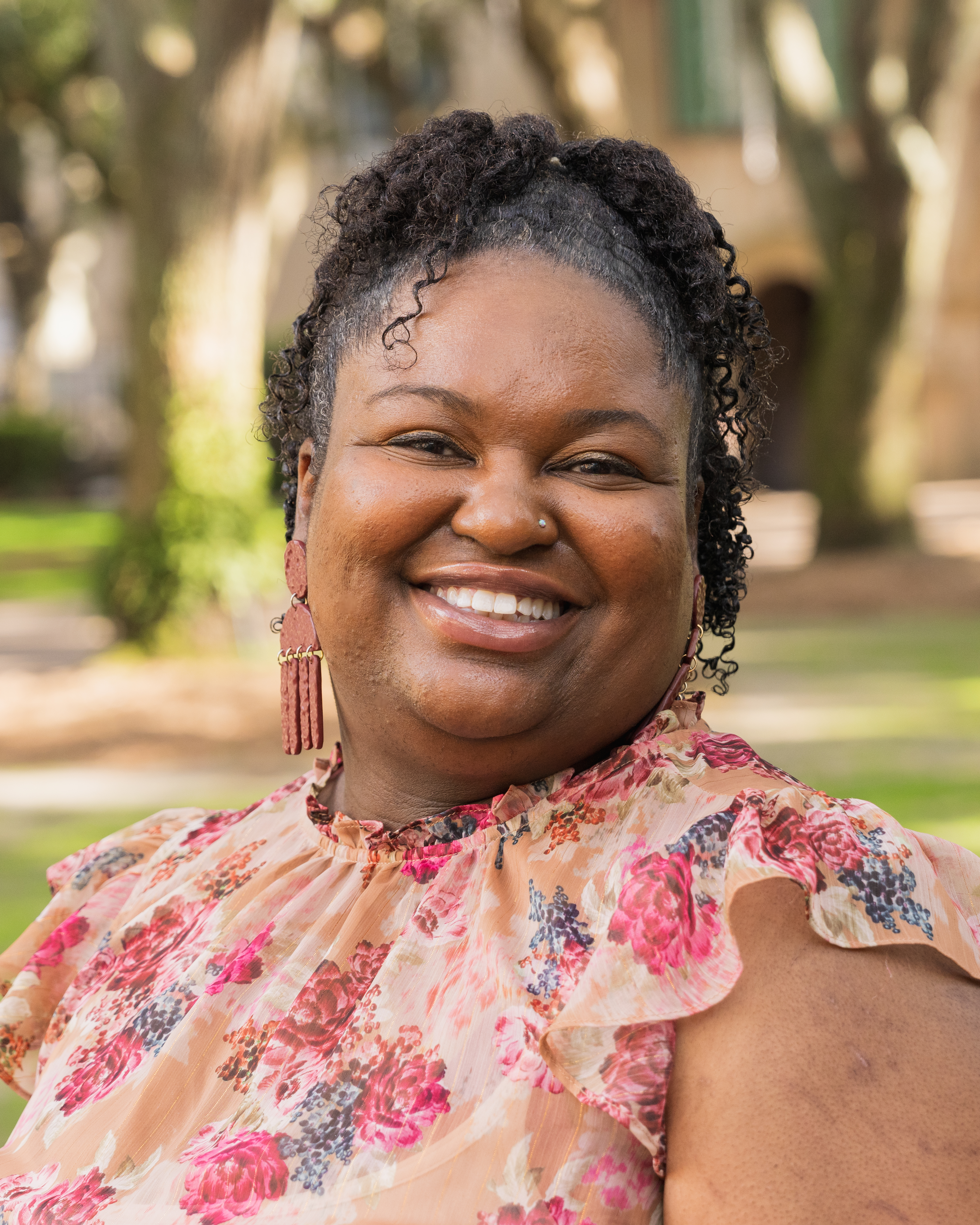
Tiffany Harris
Assistant Professor of Educational and Social Foundations
Education
- Ph.D. in Educational Policy Studies, University of Illinois at Urbana-Champaign
- Minor in Gender and Women's Studies
- Dissertation Title: The South Still Got Something to Say: An Atlanta-centric Analysis of Intergenerational Pedagogies
- Ed.M. in Educational Policy Studies, University of Illinois at Urbana-Champaign
- B.A. in History with secondary education concentration cum laude, University of West Georgia
Research Agenda
Dr. Tiffany Octavia Harris (she, her/s, ageyutsa) is an Assistant Professor of Educational and Social Foundations and affiliated faculty in the 1) African American Studies, 2) Environmental and Sustainability Studies, and 3) Women’s and Gender Studies programs at the College of Charleston in South Carolina’s Lowcountry region. She is a down-to-earth kumya from Atlanta, GA who is grateful to learn from and with Lowcountry binyas. Tiffany’s background is rooted in her experiences as a former social studies teacher in Atlanta Public Schools, but also as a homegirl with Saving Our Lives, Hear Our Truths (SOLHOT), an intergenerational, art-based collective celebrating Black girlhood. Harris is proudly an inaugural mentor for Sisters of Septima, a teacher leadership initiative, geared towards women of color.
As a Southern Black Native or Afro-Indigenous woman from a working-class background with invisible disabilities, she investigates how social and cultural foundations in society relate to schools. Tiffany’s interdisciplinary scholarship intertwines—autoethnography, culturally relevant pedagogy, Black Girlhood + Feminist studies, digital humanities, Indigeneity, speculative fiction, traditional ecological knowledge, and the U.S. South—all fused into teacher education. She, therefore, intentionally examines perspectives outside of education to address schooling disparities by envisioning pedagogy as activist, ancestral, environmental, metaphysical, familial, liberatory, and spatial elements.
Tiffany embraces a multifaceted archives approach to challenge historical narration and offers alternative storytelling. She wholeheartedly believes that human survival is interdependent with ecological restoration. Harris’ debut experimental film, Becoming, embraces nature to interpret Black girlhood through the central concept of node (or supporting stem points on plants and trees) which functions as a metaphor for world making and healing. Tiffany recently has been featured as a background actor in three short films about Black Southern experiences, specifically Gullah Geechee communities. Harris embodies servant leadership functioning as a community liaison for place-based inquiry opportunities. Furthermore, her academic publications and creative craft include themes connected to ancestral knowledge, experiential learning, humanizing practices, and cultural organizing: all designed towards enacting and imagining a more equitable world.
Courses Taught
- Race, Gender, and Environment (Environmental and Sustainability Studies)
- Critical Approaches to Engaged Pedagogy
- Educational (In)Equity and Gifted Programs (Honors College)
- Walk My World Ireland (Spring Break Study Abroad)
- Schooling and Society: Learning from Lived Experiences (First-Year Experience)
- Foundations of Education (Multicultural Understanding & Global Citizenship + General Education Humanities)
- Race, Class, and Gender
- Social Studies and Humanities Methods
Selected Publications
Harris, T.O. (2026) Flowers for Palestine: From Holy City to Holy City. Critical Education, 17(1), 211-250. https://doi.org/10.14288/ce.v17i1.187118
Harris, T.O. (2025). Afrofuturism and Indigenous Futurism are Democracy: STEM Possibilities for (Re)Humanizing Pedagogy in Education. Encounters in Theory and History of Education, 26, 114-134. https://doi.org/10.24908/encounters.v26i0.20015
Harris, T. O. (2025). Dreaming of an otherworldly elsewhere: A Black girlhood speculative approach to teacher education. Review of Education, Pedagogy, and Cultural Studies, 47(2), 330–350. https://doi.org/10.1080/10714413.2025.2476355
Harris, T.O. (2024). [Review of] Fire dreams: Making Black feminist liberation in the South, by Laura McTighe with Women With a Vision. Ethnic and Racial Studies, 1-2. https://doi.org/10.1080/01419870.2024.2440137
Harris, T.O. (2024). Learning to love: A letter of becoming via citational politics. In S. Travis, A. G. Smith, C. Hernández-Cabal & J. Lucero (Eds.), Experiments in art research: How do we live questions through art? (pp. 171-173). Routledge. https://doi.org/10.4324/9781003430971
Harris, T.O. (2022, December). Ancestral plane: Buried in plain sight. Surge: The Lowcountry Climate Magazine. Issue 3. Page 11.
Welton, A.D. & Harris, T.O. (2022). Youth of color social movements for racial justice: The politics of interrogating the school-to-prison pipeline. Educational Policy, 36(1), 57-99. https://doi.org/10.1177/04821105972889590
Harris, T.O. (2022, April). The south (still) got something to say: An Atlanta-centric analysis of intergenerational pedagogies. [Doctoral dissertation, University of Illinois at Urbana-Champaign]. Illinois Digital Environment for Access to Learning and Scholarship. https://hdl.handle.net/2142/115770
James-Gallaway, A. & Harris, T.O. (2021). We been relevant: Culturally relevant pedagogy and Black women teachers in segregated schools. Educational Studies. 57(2), pp.124-141. https://doi.org/10.1080/00131946.2021.1878179
Welton, A. D., Harris, T. O., Altamirano, K., & Williams, T. (2017). The politics of student voice: Conceptualizing a model for critical analysis. In S. L. Diem & M. D. Young (Eds.), Critical approaches to education policy analysis: Moving beyond tradition (pp. 83-110). New York, NY: Springer. https://doi.org/10.1007/978-3-319-39643-9_5
Welton, A.D., Harris, T.O., LaLonde, P.G., & Moyer, R. (2015). Social Justice Education in a Diverse Classroom: Examining High School Discussions about Race, Power, and Privilege. Equity and Excellence in Education. 48(4), pp. 549-570. https://doi.org/10.1080/10665684.2015.1083839
Honors and Awards
2026
- Septima P. Clark Educator Award | Avery Research Center for African American History and Culture
- Honors an educator or historian who is making meaningful strides in teaching Black history and advancing equitable educational pedagogies.
2025
- Cistern Standard Plaque | Office of Human Resources
- In appreciation of your Embodying the Cistern Standard Core Values and following the Cistern Standard.
2024
- Women’s and Gender Studies Impact Grant | Mellon Foundation “Affirming Multivocal Humanities”
- CofC Cistern Standard of Public Mission (twice) | Office of Human Resources
- CofC Cistern Standard of Innovation | Office of Human Resources
- CofC Cistern of Standard of Integrity | Office of Human Resources
- CofC Cistern Standard of Diversity, Equity, and Inclusion | Office of Human Resources
- CofC Cistern Standard of Student Centeredness | Office of Human Resources
2023
- CofC Cistern Standard of Academic Excellence | Office of Human Resources
- Research and Development Support Funding | School of Education
- Scholarship for Teaching and Learning Grant | Center for Excellence in Teaching and Learning (CETL)
- Michael A. Allen Heritage Interpretation Scholarship | Avery Research Center for African American History and Culture
2022
- Social Studies Educator from Illinois | Marquis Who’s Who in America
- Outstanding Graduate Student Research Prize, Humanities Research Institute | University of Illinois at Urbana-Champaign
- The Dr. Ruth Nicole Brown Coalition Award, Women’s Resource Center | University of Illinois at Urbana-Champaign
2020-2021
- Smalley Graduate Research Fellowship, Department of Gender and Women’s Studies | University of Illinois at Urbana-Champaign
2018-2022
- Diversifying Higher Education Faculty in Illinois Fellowship | Illinois Board of Higher Education
Press and Media
Interviewee. (2026, May). Featured Participant. In Geechee Sunflowa, a documentary honoring Black Southern womanhood, ancestry, growth, and land relations.
Ring Shouter. (2025, June). Featured Extra. In Bateau, a short film set in a Gullah Geechee fishing community during the Reconstruction Era in South Carolina’s Lowcountry. Blending realism and surrealism, the story follows a young Gullah boy navigating grief and transformation after the disappearance of his grandfather.
Church Chorus. (2025, May). Featured Extra. In HomeGoing, a short film (directed by Julie Dash) commissioned by the Brick Gallery and the Los Angeles MOCA museum as a tribute to the Emmanuel 9—the nine lives lost inside the Mother Emmanuel AME Church June 2015.
Spoken Word Performer. (2024, March). Creative Guest Speaker. Hosted by Prose & Woes. Cork, Ireland.
Open Mic. (2023, December). Creative Guest Speaker. Hosted by Teaching Fellows. Department of Teacher Education | College of Charleston.
Black Girl Genius Week. (2022). Dreaming about SOLHOT in Charleston. Creative Guest Speaker. Hosted by Saving Our Lives, Hear Our Truths. Funded by Department of African American and African Studies | Michigan State University.
Poetry in Libra. (2022). Creative Guest Speaker. Hosted by La Estación Gallery. Funded by Department of Theatre| University of Illinois Urbana-Champaign.
*We follow the new moon in Libra to remind us that change and rebirth are on the horizon. The abundant Venusian energy is flowing to remind us that experiencing art makes possible new world-making.
Harris, T.O. (2021). Becoming [film]. Homemade, With Love: More Living Room Exhibition in the Krannert Art Museum, Champaign, IL. United States.
*An experimental film embracing nature as a way to interpret Black girlhood. The central concept of node or supporting stem points on plants and trees functions as a metaphor for world making and healing.
Harris, T.O. (2021). Restorative Justice Blackout Poetry. Workshop Facilitator. 44 Days: Honoring Black History. Saint Mary’s College of California.
Callier, D. (2016). Tell It!: A Contemporary Choral for Black Youth’s Voices. [choreopoem]. INNER VOICES Social Issues Theatre sponsored by the UIUC Counseling Center and the Department of Theatre. (Actress).
*A performance piece about the premature death of Black and queer youth, remembering their lives, healing ourselves, and dreaming of a better world which does not necessitate their death.
Vanover, C.F. & Harris T. O. (2016, November). Using an Ethnodramatic Case to Discuss Teaching and Learning in Schools Serving Vulnerable Youth. Symposium presentation at the 2016 University Council for Educational Administration (UCEA) Annual Conference, Detroit, MI.
Vanover, C., Harris, T.O., Salaam, O., Jones, R., & McConnell, H. (2014, November). Using an ethnodramatic case to discuss leadership for social justice. Symposium presented for the Annual Conference of the University Council of Educational Administration. W. Black and J. Scheurich, Chairs. Washington, DC.